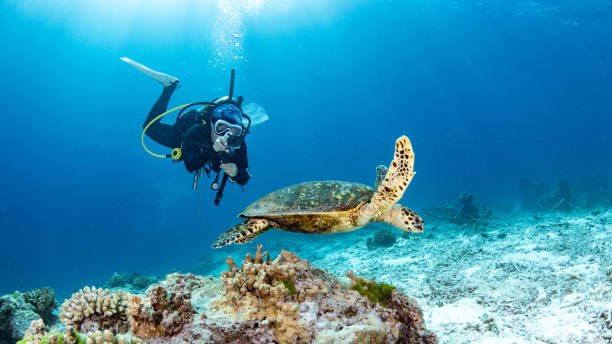
Strong current is a well known fish concentrator, and many of the top spearfishers spend a lot of time around headlands, channel mouths and offshore pinnacles. Also it can make for a very different dive than a slack day, sometimes even for worse.
Reading the water before committing to a dive
Standing waves over a reef edge, pressure waves against a mooring line, the angle of a patch of weed or soft corals on the bottom, all of these surface indicators of water movement provide a first estimate of what’s going on down below. And down below is usually very different from above. A two-knot surface flow over a slack bottom can be a totally different animal to a solid column of water of the same speed running from surface to sand.
Tide windows and the shape of the bottom
Tide tables never seem to match the real experience on a reef. The flow around a pinnacle can continue for up to 40 minutes after the predicted tide change and sometimes a channel will narrow and increase in speed just before it reaches the sand. So it is best to rely on the observed turn on a particular site rather than the table and use the first dive of the day as a ‘shakedown’ to see how the site is behaving. Dive with a weighted line or float and note the angle.
Positioning so the current works in your favour
Never try to swim against current that you cannot easily swim back against on the surface while fully inflated. Always enter upstream of the main structure of the spot you’re planning to dive, complete the dive on the drift and retrieve downstream.
Using structure as shelter
Most good diving sites have areas of eddy flow around them. Diving down the downstream side of a bommie allows you to dive in relatively still water, and then swim off down the current with the fish in the same area of lee. By approaching a site to dive along the bottom rather than in mid-water, using a hand on a piece of dead rock to steady yourself if necessary, and then staying as still as possible with fins together, you can remain unnoticed by your quarry. In strong flow, however, descending the upstream side of a site can result in you being dominated by the current for the duration of your dive, with a resultant rise in heart rate and a decrease in bottom time.
Visibility, shot discipline and target selection
Reduced sight distance can greatly change the calculation for each shot and many fish that are considered targets are also hunted in very cloudy water. A fish shot at the very edge of visibility in 4 knots of water may not be recovered and a wounded fish that runs downstream into structure can cost a great deal of money in destroyed gear and possibly even threaten the life of another diver in an unfortunate entanglement.
- Shorten your acceptable shot range to roughly half of horizontal visibility.
- Decline shots where the fish is positioned so that any run takes it into caves or bommie undercuts.
- Account for lateral drift of the shaft across the flow at longer ranges.
- Abandon a fish rather than follow it into a crevice while the current is pinning you.
Equipment choices and handling in moving water
Spearfishing gear that is good in calm conditions can become a problem in strong current. For current days it pays to choose a spearfishing gun built around quick handling rather than raw length, since the main hazard of loose line is how quickly it can find its way to get tangled up with your gear, your hands or your neck.
Guns, lines and floats
Spearfishing with a long rail gun is notoriously hard to track fish with, while on current days a shorter more manoeuvrable speargun is ideal to shoot fast in a lee and recover fast. Make sure your float line is long enough to allow for the bottom of the structure to be clear of the line but short enough so that it does not get caught in any fishing line etc. Make sure your quick release is designed to be released blind with gloves on.
| Current strength | Workable approach | Rig setup | Call it off when |
| Under 1 knot | Standard drop and hold | Standard float line, reel optional | Visibility under two metres |
| 1 to 2 knots | Live boat drift, lee-side holding | Short float line, hard float, surface marker | Surface swim upstream becomes impossible |
| 2 to 3 knots | Single-pass drift only, no repositioning | Breakaway rig, buoyant marker, no reel | Divers separate beyond boat sightline |
| Over 3 knots | Not a spearfishing window | Not applicable | Before entry |
Surface support and separation protocols
Movement, in case of drifting, can cover several hundred metres during a single shot sequence, thus precluding the option of static anchoring. We will be invariably on a live-boat with our respective skippers, all never being divers themselves.
Agreements to settle before anyone enters
- Maximum drift distance before the boat collects and repositions all divers.
- A single signal that means immediate pick-up, understood by everyone aboard.
- Who carries the surface marker buoy and when it is deployed.
- The downstream abort point beyond which the dive is finished regardless of fish.
The reward of strong current spearfishing is for those that take time to plan a dive and then execute well, not for those who worry too much about equipment and worse, sequence of events for entry, drift, recovery etc above all else.