
Age How to Tell How Old a Baby Rabbit Is A Complete Development-Stage Guide
Understanding age how to tell how old a baby rabbit is? is not about guessing size or making rough assumptions. Baby rabbits develop through tightly ordered biological stages. Each stage produces visible physical markers and predictable behavior changes. When you read those markers correctly — fur density, eye opening, ear position, movement style, feeding behavior, and body proportions — you can estimate age with strong accuracy.
This guide is written as a deep, technical yet beginner-friendly reference. It focuses only on necessary, high-value information no filler, no hype, no unrelated care advice — just precise developmental indicators you can observe and use.
Rabbit kits change faster in the first 30 days than in the next several months. That fast progression is exactly what makes age estimation possible.
Why Physical Development Is the Most Reliable Method
When evaluating age how to tell how old a baby rabbit is, physical development always outweighs size or weight. Breed and genetics play a big role in size differences. There, a small kit from two weeks ago can seem plusher as an adult to a large breed not even born yet. But development timing — eye opening, fur stages, ear lift, coordination — follows a consistent biological clock across rabbit types.
Reliable aging uses:
- Surface development markers
- Sensory development markers
- Musculoskeletal coordination
- Feeding transition signals
- Behavioral independence indicators
Never rely on only one sign. Correct estimation stacks multiple signs together.
Birth Stage (Day 0–2): Neonatal Rabbit Markers
A baby rabbit is born with the nervous system and not much physical maturity.
Core characteristics:
- Skin is pink or slightly reddish
- No visible fur coat
- Eyes completely sealed
- Ear tissue is thin and flat
- Limbs are weak and tucked close
- Neck control absent
- Movement is limited to twitching

Body length is very small, and proportions look uneven the head appears large compared to the body because muscle mass has not developed yet.
At this stage, age estimation is straightforward. No fur + closed eyes + immobility = under 3 days old.
Early Fur Emergence (Day 3–5): Surface Growth Phase
Between days three and five, hair follicles activate rapidly.
Development signs:
- Thin fuzz appears across back and head first
- Skin still visible through coat
- Eyes remain closed
- Slightly improved limb extension
- Subtle body rounding begins
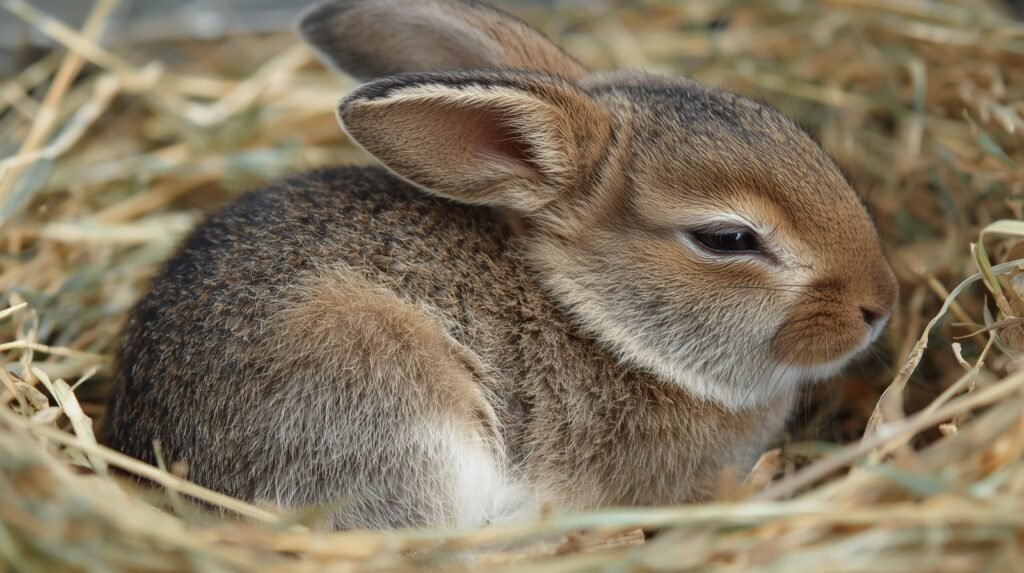
The fur looks like soft dusting rather than a coat. Density is uneven. Belly often remains thinner than the back.
For age how to tell how old a baby rabbit is, fuzz without open eyes places the kit inside this narrow early window.
Dense Fuzz Stage (Day 6–7): Transitional Covering Phase
By the end of the first week, fur coverage increases quickly.
Markers:
- Full fuzz coverage across the body
- Coat still short and plush, not layered
- Eyes still closed
- Back muscles are slightly stronger
- Head lifting begins briefly

The key distinction here is coverage vs density. Coverage is complete, but the thickness is still low. This helps separate 6–7 day kits from 10–12 day kits that have thicker coats.
Eye-Opening Window (Day 8–10): Sensory Activation Phase
Eye opening is one of the most dependable age markers in rabbit development according to rabbit eye opening timeline research.
Sequence details:
- Eyelids begin separating around day 8–9
- Full opening usually by day 10
- Vision remains blurry at first
- Light response appears quickly
- Startle reactions increase
Coat thickness also increases during this period, and whisker sensitivity becomes obvious.
If eyes are partially open and the coat is still short and plush, the rabbit is almost always within this age band. This is a cornerstone checkpoint in age how to tell how old a baby rabbit is.
Two-Week Stage (Day 11–14): Full Sensory Function
At two weeks, neurological awareness rises sharply.
Key indicators:
- Eyes fully open and alert
- For thicker and more even
- Ears beginning to lift away from the head
- Coordinated crawling
- Reaction to sound and vibration
Body temperature regulation also improves here. Kits no longer rely as heavily on constant nest warmth.
When both eyes and ears are functionally active, age typically exceeds 11 days.
Motor Coordination Shift (Day 15–18): Early Mobility Phase
Movement pattern changes define this stage more than appearance.
You’ll observe:
- First short hops
- Less belly-drag crawling
- Stronger rear leg push
- Balance attempts
- Increased nest boundary exploration
Muscle fiber strength increases rapidly during this window. The difference between day 12 and day 17 movement is dramatic.
Mobility progression is a high-confidence indicator when using age how to tell how old a baby rabbit is.
Solid Food Testing Stage (Day 18–21): Digestive Transition Begins
Digestive curiosity begins before digestive independence.
Signs include:
- Nibbling hay or grass
- Chewing motions without full intake
- Still nursing but less frequently
- Upright sitting posture appears
- Increased grooming behavior
Tooth usage becomes more visible now. The cutting edges of the incisors are sharper and more distinct.
This mixed feeding behavior strongly suggests a three-week age range.
Structural Body Change (Week 3–4): Miniature Rabbit Form
At this point, body proportions shift.
Development traits:
- Torso lengthens
- Head-to-body ratio normalizes
- Ears upright and responsive
- Fur resembles adult texture
- Movement is smooth and repeatable
This is when many people underestimate age because the rabbit “still looks small.” But proportion not size is what matters.
Weaning Progress Stage (Week 4–5): Nutritional Independence Building
Weaning is gradual, not instant.
Markers:
- Regular solid food intake
- Water drinking observed
- Nursing reduced significantly
- Increased daytime activity
- Social play behavior appears
Digestive enzymes for plant fiber processing are now active at higher levels. Stool shape also becomes more defined a subtle but real biological marker,especially when comparing rabbit pellet structure differences.
Juvenile Movement Maturity (Week 6–8): Functional Independence
Movement becomes athletic and controlled.
You’ll see:
- Fast directional hopping
- Jump and land control
- Self-grooming routines
- Strong alert posture
- Fully solid diet
At this stage, physical aging becomes harder because breed variation begins to dominate appearance.
Teeth as a Supporting Age Indicator
Dental clues support — but do not replace — other markers.
Useful observations:
- Very young kits show tiny translucent incisors
- By 3–4 weeks, incisors are clearly visible
- Chewing wear appears after consistent solid food intake
- Jaw strength increases with the hopping stage
Teeth help refine estimates when combined with fur and behavior signals.
Behavior Sequencing for Age Confirmation
Behavior follows a predictable order:
Nest-bound → crawl → wobble hop → confident hop → explore → independent feed.
If behavior and body markers disagree, behavior usually reveals the more accurate age bracket.
Example: A fully furred rabbit that cannot hop is younger than a thinner rabbit that hops confidently.
That sequencing principle is central to precise age how to tell how old a baby rabbit is evaluation.
High-Accuracy Age Estimation Method (Stacked Markers)
Use this layered method:
Check eyes → check fur density → check ear position → check movement → check feeding behavior → confirm with teeth.
Each layer narrows the window. Three or more matching indicators usually place age within a 3–4 day accuracy band in early life stages.
Frequent Age Estimation Errors
Common technical mistakes:
Using weight charts — unreliable across breeds
Using size photos — misleading without scale
Assuming fur thickness equals age — varies by genetics
Ignoring movement quality — critical marker
Judging by color pattern — unrelated to age
Correct aging is developmental, not visual alone.
Conclusion: Precision Comes from Development Order
Accurate age how to tell how old a baby rabbit is? assessment comes from reading developmental order, not guessing from size. Rabbits have this very strict biological timeline: skin → fuzz → eyes open → ears lift → crawl → hop → nibble → wean → independent motion.
When you overlay physical, sensor,y and behavioral ones, though, age assessment is no longer a shot in the dark.
That structured approach is what turns observation into accurate age identification.