
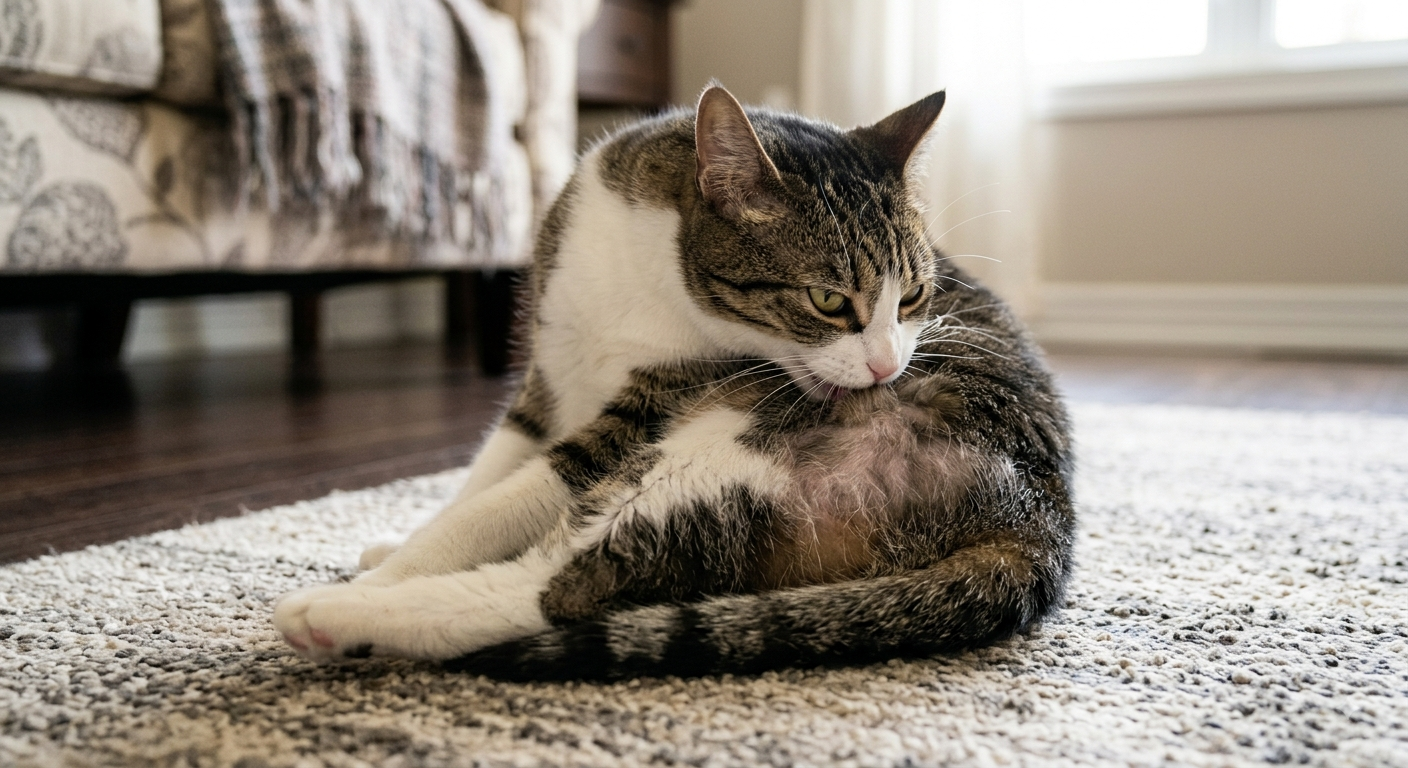
Why Is My Cat Pulling Her Hair Out?
If you’re wondering, why is my cat pulling her hair out, you’re probably noticing something more concerning than ordinary grooming. Cats naturally spend considerable time grooming themselves, but repeatedly biting, licking, chewing, or pulling at their fur can lead to thinning patches, bald areas, irritated skin, or sores.
The Behavior Is Officially Referred to as Overgrooming When the behavior is referred to in Veterinary circles, this behavioral response is often and called “overgrooming” or “excessive grooming.” This not a diagnosis – its rather the symptom of problem. This problem often includes but is not limited to; allergies, insects and parasites, skin infections, pain, itching, and stress-related actions.
According to Cornell University’s College of Veterinary Medicine; behavior, especially those tied to their appearance, can be directly linked to dermatology issues, which also include behavior conditions.
Asking ” how do I get my cat to not pull out fur”? Takes a back seat to figuring out what is actually happening.
What Normal Cat Grooming Looks Like
Before deciding why is my cat pulling her hair out, it helps to understand normal grooming.
Cats regularly lick their coats to remove dirt, distribute natural oils, and maintain their fur. Grooming is an ordinary part of feline behavior.
The concern begins when grooming becomes excessive or causes visible changes.
Look for:
- Bald or thinning patches
- Broken hairs
- Red or irritated skin
- Scabs
- Small wounds
- Repeated licking of one area
- Fur that appears shorter in certain spots
- Frequent biting or chewing at the coat
- Grooming that interrupts eating, sleeping, or normal activities
If the coat is changing because your cat is repeatedly attacking one area, something may be triggering the behavior.
Fleas Are an Important Possibility
One of the first things to consider when asking why is my cat pulling her hair out is flea exposure.
Fleas can cause extensive itching in cats. A cats can be highly allergic to flea saliva which will result in a severe allergic reaction which is called Flea Allergy Dermatitis. According to Cornell Flea Allergy which cause intense itching and skin irritation in cats.
You may notice:
- Excessive scratching
- Biting around the tail base
- Licking the back or hindquarters
- Small scabs
- Hair loss
- Restlessness
Importantly, not seeing fleas doesn’t automatically rule them out. Cats groom themselves thoroughly, and fleas may be difficult to spot.
If flea exposure is possible, speak with your veterinarian before choosing a flea-control product for your cat.
Could Allergies Make a Cat Pull Out Fur?
Yes.
Allergies cause itching, a skin reaction that results in over grooming . Allergens include outdoor environmental elements, some foods, or flea saliva. In an allergic cat, he or she may over groom specific regions because skin areas are itching or irritated.
Although the signs of a food allergy are most certainly dermatological, it’s impossible to diagnose or treat the disorder through a trial-and-error feeding trial alone.
The appropriate diagnostic method in a patient suspect of suffering from an food allergy may be prescribed by an veterinarian.
Skin Infections Can Cause Excessive Grooming
Skin infections are another possible explanation for why is my cat pulling her hair out.
Fungal, bacterial, or other skin conditions can cause irritation, itching, scaling, or changes in the coat.
This one is actually more than interesting in that it is not only a fungal infection but can be transferred from cats into humans as well as other animals. Cornell mentions the fact that ringworm may cause some changes in your cat, such as patchiness of hair loss, or skin alterations. So if your feline has round patches of lost hair, crusted or flaky skin patches or any unusual modifications to the skin, see your local vet. Do not generalize-a round patch of hair loss could definitely not always be from stress..
Ear Problems Can Lead to Hair Pulling
Sometimes the problem begins with the ears.
Ear mites, infections, allergies, or inflammation can cause significant irritation. A cat may scratch around the ears or repeatedly groom nearby areas.
Look for:
- Frequent ear scratching
- Head shaking
- Dark material inside the ears
- Redness
- Sensitivity around the ears
- Hair loss around the head or neck
A veterinarian can examine the ears and determine whether parasites, infection, inflammation, or another problem is responsible.
Pain Can Cause a Cat to Overgroom
Another cause for grooming that is sometimes missed is pain.
Cats may groom or lick an area that is sore or is painful to the cat.
A cat that has joint pain, or other physical pain in another area of their body, such as the abdomen, may fixate on grooming that area.
The grooming may appear to be behavioral when there is a physical problem that is causing the grooming to occur.
If your cat starts to focus a lot on one particular area you should make sure to check if this corresponds to any physical change in the cat.
Stress Can Cause Overgrooming
After ruling out medical causes, stress or anxiety becomes a more reasonable factor.
Cats may or may not be sensitive to changes in the environment. For example, change in people, animals, routine, house structure, and home life may trigger these behavior changes.
The term “psychogenic alopecia” may be used when stress causes over-grooming. However, when you think you might be dealing with a behavioral issue you first have to take measures to diagnose physical problems and if there were none of then you will have your behavioral issue.
The two are extremely different.
You cannot give a cat only a prescription to de-stress because he has fleas, skin infection, allergies, pain, etc.
Common Sources of Stress for Cats
When considering why is my cat pulling her hair out, think about anything that changed before the behavior started.
Potential stressors can include:
- Moving to a new home
- A new pet
- A new person in the household
- Changes in daily routine
- Construction or loud noise
- Conflict with another cat
- Changes in access to food or litter areas
- Reduced opportunities for hiding or resting
Not every cat reacts to these situations in the same way.
A cat that appears outwardly calm can still experience environmental stress.
Why Is My Cat Pulling Hair From Her Belly?
The belly is another one of those over-grooming prone areas.
If your cat is licking and chewing her belly incessantly, several different things could be going on. These range from a true allergic condition to simple external parasites to irritations, pain, or stress-induced grooming. Only a visit to the vet will confirm what it is; the fact that it’s on the belly is not useful information by itself. If the fur appears to be thinning and the skin irritated it a veterinary examination can help distinguish a skin problem from behavioral overgrooming.
Why Is My Cat Pulling Hair From Her Legs?
Leg hair loss may occur from over-grooming as well.
But cats may experience skin sensitivity or pain in many places, so leg location is alone an insufficient way to identify the problem.
Note whether the hair loss is symmetric (uniform across both legs) or isolated to one particular spot.
Also observe for any redness, scabs, sores, swelling or other abnormalities that may be present.
All of these clues assist the veterinarian in diagnose what the problem is.
Why Is My Cat Pulling Hair Out But Has No Fleas?
This is frequently overlooked. The cat may or may not show Fleas Fleas are not the only cause of self trauma and or itchy behavior even if there are no visible fleas. Other causes include environmental exposure, allergy, infection of the skin, mites, pain, or over-grooming caused by some stressor or in response to self pain. The cat may have “groomed himself clean”, meaning he has groomed the fleas away.
What Should You Do First?
If you’re asking why is my cat pulling her hair out, begin by observing rather than immediately trying to stop the grooming.
Look at:
- Where the hair loss is occurring.
- Whether the skin is red or damaged.
- Whether your cat is scratching as well as licking.
- Whether fleas or flea dirt may be present.
- Whether the behavior started suddenly.
- Whether anything changed in the household.
- Whether appetite, activity, or litter-box habits have changed.
These observations can make a veterinary appointment much more productive.
Don’t Punish Your Cat for Overgrooming
A punitive approach is unlikely to address the root cause.
If the cat is grooming as the result of an itchy or sore spot then punishment will not alleviate the physical cause.
If stress is an element of grooming punishment will only introduce more stress. Try to address the reason rather than punish the action.
How a Veterinarian May Investigate the Problem
A veterinarian may begin with a physical and dermatological examination.
Depending on the findings, they may investigate possible:
- Fleas or other parasites
- Allergies
- Skin infections
- Fungal infections
- Pain
- External irritation
- Behavioral causes
The diagnostic process depends on the cat’s symptoms and medical history.
Sometimes several possibilities overlap, so finding the answer may require more than one step.
When Is It Time to Take Your Cat to the Vet?
Make a veterinary appointment if your cat’s fur pulling is persistent, worsening, or causing visible skin damage.
You should be especially attentive if you notice:
- Bald patches
- Open sores
- Bleeding
- Crusting
- Significant redness
- Swelling
- Severe itching
- Changes in appetite
- Weight loss
- Reduced activity
- Changes in normal behavior
A cat that is repeatedly damaging its skin shouldn’t simply be expected to stop without investigating the reason.
When Is It More Urgent?
Visit the veterinarian immediately if hair pulling also comes with any signs that the cat may be very sick: Signs could include weakness, shortness of breath, pain or lameness, significant wounds, swelling of the face, or drastic behavior changes. Skin issues are not always an emergency, but the occurrence of this in conjunction with any of the signs above could necessitate the change.
How to Make Your Cat More Comfortable While Waiting for Care
As you’re arranging the vet visit, use basic supportive care measures.
Confine your cat to indoors where the substance that caused the skin reaction can be removed and thus cause less irritation.
Do not apply human creams, essential oils or other treatments to the affected area unless instructed to do so by your vet.
Keep water and food readily available and clean litter area.
If you suspect fleas, do not mix various flea treatments without instructions from your vet; products for use on other pets are toxic for use in cats.
Why Treating the Cause Matters
The visible problem is often the missing fur.
But the missing fur isn’t necessarily the underlying disease.
If fleas are responsible, flea control is important.
If allergies are responsible, the trigger and inflammation need to be addressed.
If there is an infection, appropriate veterinary treatment may be necessary.
If pain is causing the grooming, treating the pain is more useful than simply preventing the cat from licking.
And if stress contributes after physical causes have been ruled out, environmental and behavioral changes may help.
This is why answering why is my cat pulling her hair out is more important than simply asking how to stop the behavior.
How to Reduce Stress at Home
If your veterinarian believes stress might be a factor consider making your cat’s environment more predictable: Provide private, quiet, and comfortable rest areas where she can hide if she feels the need for privacy. Keep feeding and litter box cleaning schedules on a relatively predictable schedule when possible. Allow your cat to exhibit her normal behavior like playing, exploring, scratching, and resting.
If there are other cats in the home, assess if they are keeping each other away from food, water, litter boxes, or desirable sleeping spots.
Environmental modification can be extremely helpful for cats experiencing changes in the household.
Can Diet Help?
The best cat food is crucial to the general well-being of your feline, but changing your cat to new foods is not the universal solution for over-grooming. Your veterinarian, if concerned about allergies to food sources, may recommend a regulated diet trial instead of random meal switching. A well-followed trial is important, as changes back to and forth will inhibit establishing if dietary improvements make any difference.
A Practical Cause-and-Clue Guide
| What You Notice | Possible Cause to Investigate |
| Intense itching and scratching | Fleas, allergy, parasites |
| Bald patches with scaling | Skin or fungal problem |
| Grooming one specific painful area | Possible pain or discomfort |
| Hair loss with household changes | Stress may contribute |
| Ear scratching and head shaking | Ear problem or parasites |
| Red, irritated skin | Inflammation, allergy, infection |
| No obvious skin problem but persistent grooming | Medical causes should still be ruled out |
This isn’t a diagnostic chart. Several causes can produce similar symptoms, and more than one problem can occur at the same time.
Keep a Simple Record
If you’re still wondering why is my cat pulling her hair out, recording the pattern can be surprisingly useful.
Note down where you see this grooming and when, if there is any trigger that precedes it, etc. You could also consider taking photos of the area over a few days, which will be helpful to a vet if the behaviour occurs when you are not present at the vet practice.
Final Thoughts
If you’re asking why is my cat pulling her hair out, excessive grooming should be treated as a symptom rather than a diagnosis.
Fleas, allergies, skin infections, parasites, pain, environmental irritation and stress are all possible candidates. The veterinary literature is quick to point out that physical causes must be explored and assumed before overgrooming is simply a behavioral problem. Examine the areas where hair is being lost and evaluate the skin for any abnormalities.
Think about what might have changed in the cat’s environment but do not dismiss the physical possibilities just because the cat appears “happy”.
Keep human medications and unapproved skin preparations away from your cat. A vet visit is in order when there is actual skin damage, baldness, or repetitive scratching/grooming of the same areas.
Ultimately, why is my cat pulling her hair out can only be answered reliably by identifying what is driving the grooming. Once the underlying cause is found, treatment can focus on the actual problem rather than simply trying to stop your cat from grooming.
FAQs About Why Is My Cat Pulling Her Hair Out?
1. Why is my cat pulling her hair out but not scratching?
Some cats, when they itch or feel discomfort, try to soothe themselves by licking or pulling away their fur. It is commonly triggered by fleas, allergies, infections, pain, or several other issues.
2. Can be caused by stress?
Sometimes it can be caused by stress, but medical conditions should be checked before assuming it is stress-induced.
3. Can fleas cause it?
Yes, because fleas can cause irritation to the skin, and cats with sensitivity can groom themselves too much; resulting in hair loss. Even if you cannot see any fleas, it does not mean that they are not present.
4. Should I stop my cat from grooming?
If it is normal grooming, you should not stop her. If she is excessively grooming herself and harming her fur and skin, the best course of action would be to figure out what is causing it and seek veterinary help.
5. Why is she losing hair on her belly?
Hair loss on the belly is often caused by excessive grooming. It can be triggered by allergies, parasites, infections, irritations, pain, or even stress.