

Unpleasant sensations in the upper back and chest can cause anxiety particularly when they are tight, sharp or pressure-like. Most people begin to think the worst. But most (95%) cases, in daily clinical and lifestyle settings, are musculoskeletal. Gain understanding of the structures involved, what irritates them and systematically implementing evidence based approaches for alleviating upper back and mid chest pain.
The thoracic spine (the upper back) is directly connected to the rib cage. The rib cage wraps around the front of the torso and attaches to the sternum (breastbone). This structural connectivity means that tightening or constriction in the thoracic spine often translates to discomfort felt in the chest. Likewise, tight muscles in the chest can contribute tension that spreads to the upper back.
This guide explains causes, assessment steps, corrective actions and long-term strategies in a technical but neutral and practical way. The goal here is clarity and usefulness, not selling quick fixes.
Understanding the Anatomy Behind Upper Back and Chest Pain
In order to understand how to relieve upper back and chest pain, it’s helpful to consider the relevant anatomy. The thoracic spine consists of twelve vertebrae, labeled T1 through T12. Each vertebra is connected to a pair of ribs. These ribs frame and wrap around the torso, connecting in front at the sternum through cartilage. Muscles overlay this framework, including:
- Trapezius (upper and mid portions)
- Rhomboids
- Latissimus dorsi
- Erector spinae
- Pectoralis major and minor
- Serratus anterior
- Intercostal muscles between ribs
When that posture sags forward (which is what happens during long periods of sedentary work or play) the pectoral muscles also shorten and tighten. Simultaneously, the mid-back muscles also become elongated and weakened. Over time, this imbalance leads to strain, joint stiffness and muscle fatigue.
Also, the rib joints (costovertebral and costosternal) may become stiff due to lack of movement. And since breathing relies on rib expansion, limited movement in the ribs can magnify pain in both the chest and upper back.
In understanding how to relieve upper back and chest pain, it’s important to remember that these areas are part of an interconnected system.
Common Causes of Upper Back and Chest Pain
The causes of upper back and chest pain are often overlapping. These include:
The number one cause of thoracic discomfort: poor posture, especially forward head placement and rounded shoulders. Extended time working at a computer, driving or on the phone can slowly change the position of the spine.
Muscle strain can result from lifting, frequent overhead work or sudden twisting movements.
Muscle tightness in the upper back and chest when we’re stressed. Stress often modifies breathing techniques, rigorously tightening accommodating breathing muscle tissues.
When thoracic joints remain still for a long time, they become stiff. Chronic conditions can also contribute to persistent discomfort, as seen in cases of fibromyalgia-related back pain and management, which can affect posture and upper back muscles over time.
Sleeping position could play a part, if the spine is rotated or flexed overnight.
Less so, medical causes could include things like costochondritis or rib dysfunction or spinal disc issues can produce discomfort as well. If the pain is persistent, worsening or unexplained it should be medically evaluated.
Important Medical Considerations
Before discussing how to alleviate upper back and chest pain with self-care, it’s important to rule out some serious conditions.
If the pain is accompanied by any of the following, seek emergency medical help:
- Shortness of breath
- Radiating pain to the arm or jaw
- Severe chest pressure
- Sudden onset with dizziness or sweating
- Numbness or weakness
If you experience chest tightness that seems related to meals or digestive issues, you may find guidance in this post on stopping chest tightness after eating useful.
If pain clearly varies with movement, eases with stretching, or seems muscular in origin, it is more likely to be mechanical. However, when uncertain, a professional evaluation is appropriate.
How to Relieve Upper Back and Chest Pain Through Postural Correction
Postural correction is foundational. Many cases improve significantly when alignment is restored.
Begin with the spine in a neutral position. Plant your feet flat on the floor. Let the pelvis be seated equally without tucking under too adamantly or arching up excessively. Lift the chest softly without flaring the ribs. Pull the shoulders back and down — not stiffly but easily.
The head should align over the shoulders rather than forward. Even a slight forward head shift increases upper back strain considerably.
For someone working at a desk, the monitor height should be such that the eyes are looking straight ahead. Elbows should be resting close to 90 degrees and the keyboard should not require you to reach.
Exercises for postural endurance can train those adjustments to become stronger. Staying in correct alignment for longer and longer periods trains supportive muscles to hold the position naturally.
Thoracic Mobility: Restoring Movement to the Upper Spine
When upper back mobility is limited, hsoulders as well as lower back compensastes and having stiffness and pain. Joints are getting less lubricant and tissues become less elastic without movement.
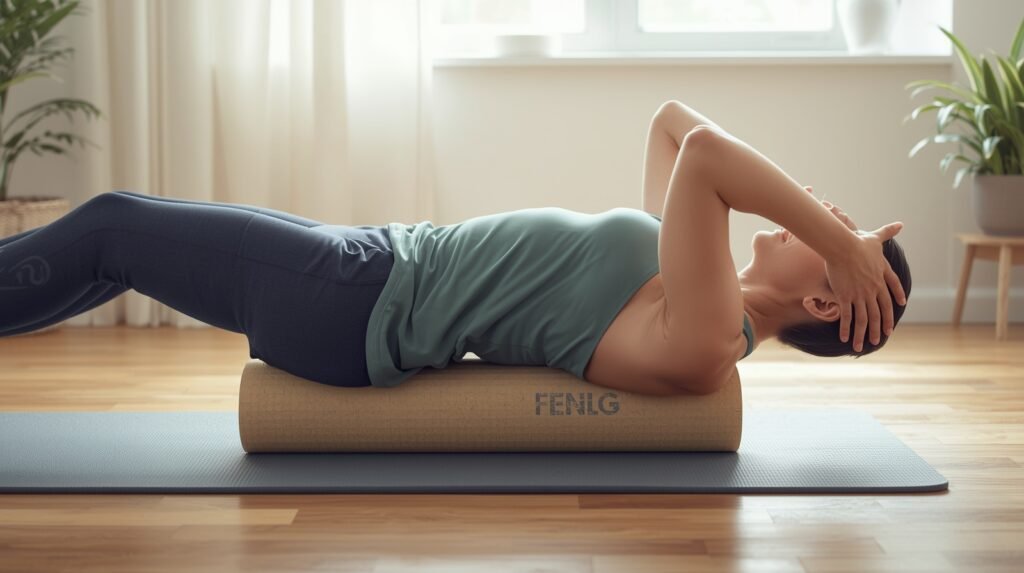
Gentle thoracic extension over a foam roller facilitates mobility. Lie on your back on the floor and place the roller horizontally underneath your upper back.Place your hands behind the head to support it and gently extend backwards over the roller. Move slowly and breathe steadily.
We also do seated rotation exercises to restore movement. Use the rib cage to rotate — not just the shoulders.
Better to show up consistently than too intensely. Stiffness can be gradually reversed and comfort improved with daily mobility practice.
Stretching Tight Chest and Shoulder Structures
Tight anterior muscles frequently pull the shoulders forward.
A doorway stretch is effective when performed properly. The arms should be higher than the shoulders to reduce strain. Gently lean forward until you feel a stretch across the chest.
Another helpful stretch involves the pectoralis minor. Lie down lengthwise on a foam roller along the spine, letting the arms fall out to the sides. Gravity gently opens the chest.
Stretching should produce mild to moderate sensations — not pain. Overstretching can be more irritating than relaxing on tissues.

Strengthening the Upper Back for Structural Balance
The solution is not simply stretching. The posterior chain gives you long-term stability.
Exercises to retract the scapula work the rhomboids and mid-trap. These muscles counteract forward rounding.
Wall slides are effective for retraining shoulder mechanics. Set up facing a wall with the back to it and reach the arms overhead while leaving the ribs in a neutral position.
Resistance band rows fortifies balanced shoulder movement. Controlled motion is essential. Jerking movements reduce effectiveness.
Strengthening sessions, twice to three times a week, are excellent for equipment to reduce recurrence significantly.

Breathing Mechanics and Rib Mobility
Breathing patterns impact tension in the chest and upper back. Using accessory muscles too much causes overuse, creating tightness.
Diaphragmatic breathing lowers expansion into the rib cage. Try lying down on your back with one hand resting on your abdomen. Breathe in, letting the belly and lower ribs expand. Exhale fully and calmly.
This technique opens your ribs, putting your body into a less tension filled state. Chest tightness lessens when breathing is more efficient — this is something so many people feel.

Ergonomic Adjustments for Long-Term Relief
Learning how to relieve upper back and chest pain requires some environmental modifications.
Chairs should support the spine’s natural curve. The height of the desk should allow comfortable resting of forearms.Put your go-to stuff where you can grab it quick.
Standing desks may help if alternated properly. However, standing with poor posture can create similar strain. Movement variation is more important than any single position.
Every 30–60 minutes of micro-breaks to avoid built-up strain. Just standing up and rolling the shoulders a bit can help reset tension.
Heat and Soft Tissue Techniques
Heat therapy improves blood circulation and tissue extensibility. Applying a warm compress for about 15–20 minutes can help relax muscle guarding.
Pressing a massage ball up against a wall can act like self-massage between shoulder blades that are tight.
Foam rolling should be slow and controlled, and should not target direct pressure to the spine itself.
They are not a panacea, the soft tissue methods, they are supportive tools.
Stress and Muscle Guarding
Acute stress works to increase sympathetic nervous system activity. Muscles are softly contracted for long durations.
Mindful relaxation techniques can break this cycle. Relaxation techniques — progressive muscle relaxation, slow breathing or even short walking breaks — can reduce muscle guarding.
Someone under deadline pressure might, say, raise their shoulders without thinking about it for hours. Awareness and correction reduce this pattern.
Talking about how to relieve upper back and chest pain, stress management is often neglected.
Sleep Position and Recovery
The sleep position is a factor that affects spinal loading for the long haul.
Side sleepers need a pillow that offers neutral neck position in alignment with the spine. Using a pillow between the arms prevents rounding of the shoulders.
Avoid overly high pillow height if you are a back sleeper. The hope is alignment, not busy flattening.
Recovery is enhanced when tissues are not stressed overnight.
Activity Modification and Gradual Loading
Musculoskeletal pain almost never requires complete rest. This controlled movement will enhance circulation and therefore heal you.
But heavy lifting or high-intensity workouts may require some temporary modifications.
Gradual re-entry to full activity keeps us from reinjuring ourselves. So someone getting back into the gym after experiencing pain should work with less resistance and in a more controlled fashion.
Balanced loading builds resilience.
Duration and Recovery Expectations
Slight posture-related pain can get better in one or two weeks with consistent correction. [Muscle and tendon strains can take weeks, depending on the severity of the injury.]
Chronic patterns need long standing adjustments with respect to posture, strength and habits.
Patience is necessary. Tissue adaptation takes time.
Long-Term Prevention Strategies
You can prevent things but consistency is the key panacea not a one time heroic effort.
Monthly posture check-ins, weekly strengthening sessions and frequent mobility work cement the changes.
Hydration and gross sections of the body all add to the health and well-being of tissues as well.
Strengthening of muscle in the upper back helps reduce fatigue while sitting for long periods.
Daily practices of small habits avoid repeated discomforts.
Final Thoughts
To learn how to relieve upper back and chest pain, you’ll need to study anatomy; correct postural deviations; restore mobility around your shoulder blade, spine, and ribs; strengthen the muscles that support the shoulder blades and rib cage; and adjust habits in daily life. Most cases do well with consistent, evidence-based self-care.
It takes a while, but it works. You target the cause, not a superficially band-aided symptom.
If the pain continues or seems unusual, that’s where getting it checked out becomes important. Otherwise, steady, informed action is usually all that’s needed to return comfort and support spinal health over the long term.