
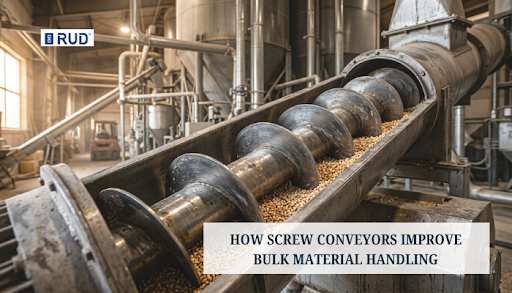
Screw conveyors improve bulk material handling by providing a continuous, enclosed method for moving powders, granules, and heavy elements. They minimise spillage, reduce manual handling, and keep maintenance overhead low.
Moving bulk supplies sounds simple until you’re dealing with abrasive minerals, floury powders, or slow-flowing products that clog, spill, or back up your whole line. If your site is dealing with that kind of problem, the system you’ve chosen probably isn’t built for the material you’re running.
RUD Australia has been engineering and manufacturing conveyor systems from our Brisbane facility for over 40 years. We know what works on Australian industrial sites and what causes problems down the track.
This guide covers the right screw conveyor setup for your material type. It also explains how these systems work alongside bucket elevators for complete bulk handling on site. Read on to find the right conveying solution for your facility.
What Screw Conveyors Do on a Heavy-Duty Industrial Site
Heavy-duty industrial conveyor systems use a rotating helical blade inside a trough or tube housing. An electric motor drives the blade, pushing bulk elements forward in a continuous, controlled flow. This mechanism handles a surprisingly wide range of jobs on the production floor, well beyond simple point-to-point transport.
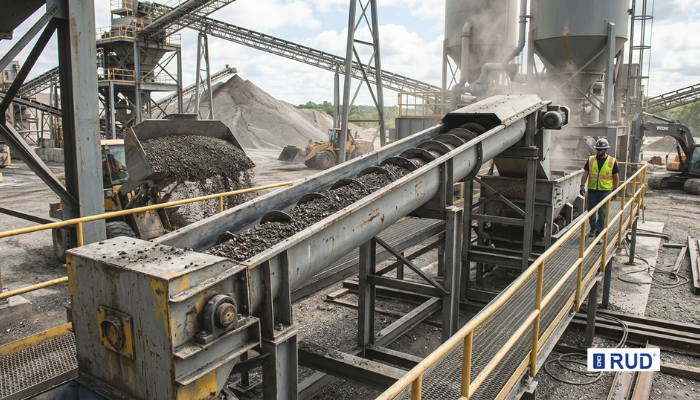
Take a look at what RUD Australia’s BULKOS screw conveyors deliver on-site:
- Handles Difficult Bulk Materials: BULKOS conveyors move fine-grained, coarse-grained, abrasive, and slow-flowing materials reliably. We’re talking raw elements like cement and potash through to heavy loads of minerals and industrial waste. Mining, food processing, and manufacturing facility applications all rely on this kind of consistent material flow.
- Performs Multiple Functions in One System: In addition to transporting bulk goods, these conveyors perform loading, mixing, emptying, and cooling within a single enclosed system. A multi-function setup like this saves floor space and keeps your production line tighter without adding complexity.
- Scales to Your Throughput Requirements: BULKOS systems are available in single, double, or triple screw configurations to match your site’s capacity demands. From there, speed adjustments give you precise control over increasing throughput. And because the design keeps moving parts to a minimum, low maintenance means less downtime and more consistent output.
The power source, drive mechanism, and enclosed housing all work together as one integrated unit. A well-specified horizontal conveyor running on this principle stays reliable under real working conditions.
The Right Screw Conveyor Setup for Your Bulk Material Type
Choosing the right conveyor type upfront saves you from unplanned downtime, premature wear, and costly mid-operation fixes. If you’re working with abrasive or temperature-loaded materials, the setup that works for free-flowing grain simply won’t hold up. And that’s where many Australian sites get it wrong.
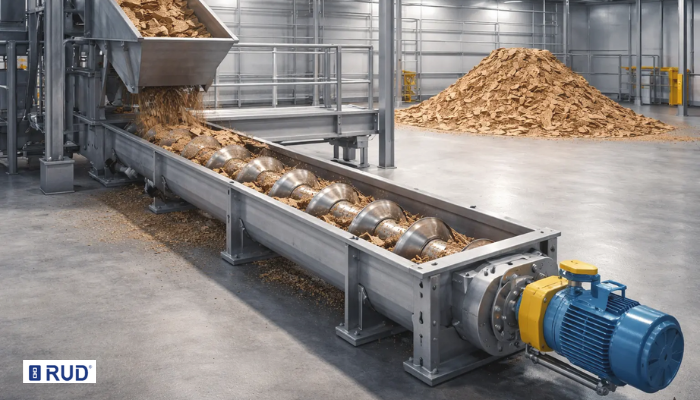
There are 3 main factors worth understanding before you spec a system.
What Determines the Right Configuration?
Material characteristics are the starting point. Abrasiveness, moisture content, temperature, and flow behaviour all determine which screw configuration, flight type, and housing material your system needs.
Getting these exact specifications right from the start is what keeps your conveyor running reliably over the long term.
How Incline Affects Performance
Inclination directly limits how much work a screw conveyor can do. A horizontal one suits controlled, short-to-medium distance transport of dry bulk materials. Inclined setups work efficiently up to 30 degrees. Beyond that point, conveying efficiency drops and power demands climb noticeably.
For steeper applications, belt conveyors or gravity rollers handle the load with better energy efficiency. And for delicate materials where product integrity needs protecting, pneumatic conveyors are worth considering. Flexible systems that combine screw and chain conveyors give sites more routing options across complex layouts.
Enclosed Design and Workplace Safety
Enclosed tubular designs prevent dust, spillage, and contamination on open industrial sites. That containment also cuts down on repetitive lifting, worker fatigue, and the risk of workplace injuries tied to manual handling.
And the numbers back this up. According to Safe Work Australia, hazardous manual tasks are among the leading causes of musculoskeletal injuries in Australian workplaces. We’ve seen this firsthand across sites in Queensland and Western Australia, where switching to enclosed conveyor systems noticeably reduced manual handling exposure for operators.
Your team works with minimal effort, operator safety improves, and the right handling solutions matched to your material keep everything running without added complexity.
How Screw Conveyors in Australia Work Alongside Bucket Elevators
Screw conveyors handle horizontal and inclined bulk material movement. Bucket elevators take over when you need high-capacity vertical lifting. Used together, these two industrial systems cover the full range of material handling on site, from ground-level intake through to elevated discharge points, without interruption to continuous flow.
Here’s how the two systems compare:
| Factor | Screw Conveyors | Bucket Elevators |
| Direction | Horizontal and inclined | Vertical |
| Best For | Enclosed, dust-sensitive operations | High-capacity vertical transport |
| Maintenance | Lower | Higher |
| Moving Parts | Fewer | More |
| Capacity | Controlled feed rates | Maximum conveying capacity |
| Ideal Applications | Dosing, mixing, metering | Lifting to elevated discharge points |
Both systems solve different parts of the bulk handling problem, and combining them is what gives your site a complete material handling flow.
Now, let’s look at how they work together on-site.
Screw Conveyors Cover Horizontal Movement
Screw conveyors move bulk materials along the production floor at controlled feed rates, including dosing and metering into downstream equipment. Smooth operation at this stage sets up everything that follows, so getting the horizontal conveyor right directly affects overall efficiency across the line.
Bucket Elevators Handle the Vertical Lift
Bucket elevators like BULKOS central chain systems deliver maximum conveying capacity in extreme conditions. They handle abrasive materials, feed fluctuations, and high product temperatures reliably.
Our team has commissioned these units across cement and minerals processing facilities in Queensland and Western Australia. And from what we’ve seen, optimal performance holds up even under continuous heavy load.
With the same chain technology running through both systems, assembly lines and packaging operations downstream stay in sync.
Paired Systems Create Complete Bulk Handling Flow
Combining screw conveyors and bucket elevators creates smooth, uninterrupted material handling systems from intake to discharge. In our experience working with Australian industrial sites, this pairing removes the bottlenecks that single-system setups can’t solve. It’s one of the more innovative conveyor solutions we recommend for sites running high volumes of bulk materials handling around the clock.
That combination improves productivity, supports operational efficiency, and gives your site a reliable material handling setup built to ensure smooth operation under real working conditions.
RUD Australia engineers both systems to work together, so you’re not left piecing together equipment from different suppliers and hoping it all lines up.
Getting the Most from Your Bulk Material Handling Equipment
The right conveyor setup reduces downtime, improves throughput, and protects your bulk materials from the kind of handling damage that adds up over time. Screw conveyors, paired with the right bucket elevators and handling equipment, give your site a complete system built for real industrial conditions.
If you’re ready to find the right solution for your facility, RUD Australia‘s engineering team is here to help. We design and manufacture conveyor systems built to your exact site requirements. That covers everything from fine powders and abrasive minerals through to heavy-duty bulk materials across mining, cement, and fertiliser operations.
Get in touch with our team today to discuss your project.